

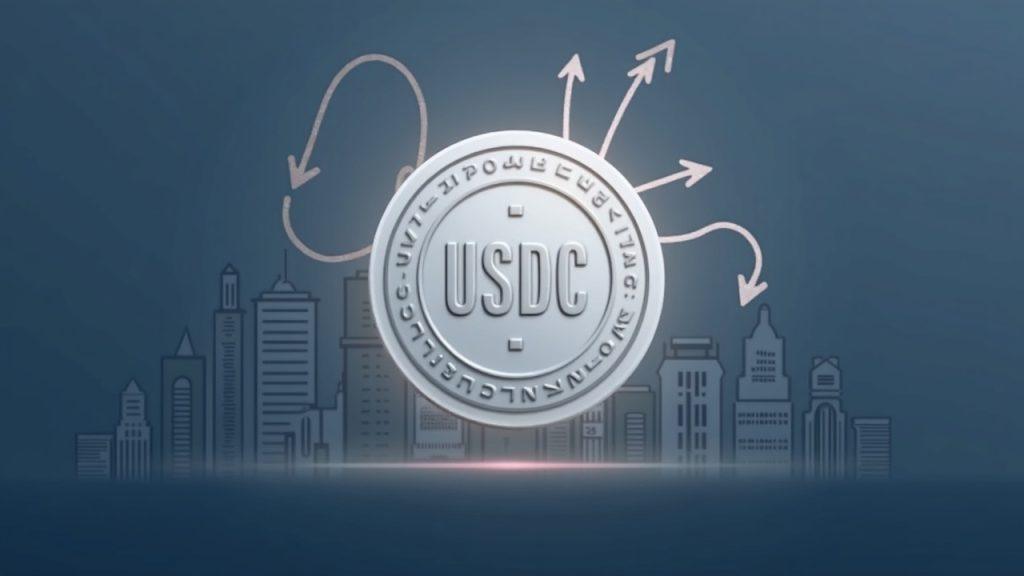
USDC’s market capitalization climbed to about $79.2 billion by mid-March 2026, putting the stablecoin within reach of its previous peak near $80 billion. The move reflected a renewed wave of dollar inflows that pushed USDC back toward record scale after a period of strong institutional demand.
Part of that demand appears to have come from the United Arab Emirates, where capital rotation into dollar-linked digital assets accelerated as local markets weakened. A meaningful share of the recent expansion was tied to large institutional and OTC flows that redirected liquidity from conventional assets into USDC.
Capital Rotation From the UAE Helped Accelerate Growth
Dubai-based analyst Rami Al-Hashimi said OTC desks in the city were struggling to keep up with demand for USDC, linking the rush in part to investor repositioning away from traditional UAE markets. The pressure on OTC desks suggested this was not just retail interest, but a larger flow of capital seeking fast access to dollar liquidity.
That shift followed visible weakness in local real estate markets. Reports cited a roughly 27% drop in Dubai property prices in October 2025 and a decline of about 31% in the DFM Real Estate Index from its peak by March 2026, conditions that appear to have pushed some capital toward digital dollar instruments.
Some sellers were even reported to be offering discounts for Bitcoin payments, a sign that digital assets were already becoming part of local transaction strategies. That detail reinforced the idea that part of the move into USDC was driven by a broader search for liquid, portable alternatives to stressed local assets.
Market participants described the pattern as strategic reallocation rather than a broad-based flight from the UAE. The flow into USDC unfolded at the same time the UAE continued building regulated digital-asset infrastructure, showing that capital rotation and policy development were happening in parallel rather than in opposition.
DeFi Integration and Regulation Also Strengthened USDC
Regional demand was only one part of the story. USDC’s deep integration into DeFi and institutional trading rails also helped lift its transaction volumes well above those of some rivals.
Mizuho reported that USDC had processed about $2.2 trillion in adjusted transaction volume year to date, compared with roughly $1.3 trillion for USDT. That volume gap pointed to growing utility as well as rising preference among users and institutions that value regulated, dollar-backed settlement assets.
Other market data supported that trend. A BVNK survey found USDC ownership had moved ahead of USDT in several markets, including Colombia, South Africa, Germany, Brazil, and the United States, suggesting a broader shift in custody and counterparty preferences.
Regulatory positioning also helped reinforce confidence. Circle’s audited structure, dollar peg, and multi-chain distribution were repeatedly cited as factors that made USDC more attractive to institutions operating under tighter compliance standards.
At the same time, policy changes in the UAE could shape how these flows evolve over time. The launch of the central-bank-registered stablecoin USDU and Federal Decree Law No. 6 of 2025 point to a future in which some cross-border dollar demand may be redirected into regulated local settlement instruments.
Rising USDC inflows are deepening dollar liquidity across DeFi and OTC markets, even as they place more strain on OTC capacity, custody infrastructure, and compliance monitoring tied to regional capital sources.