

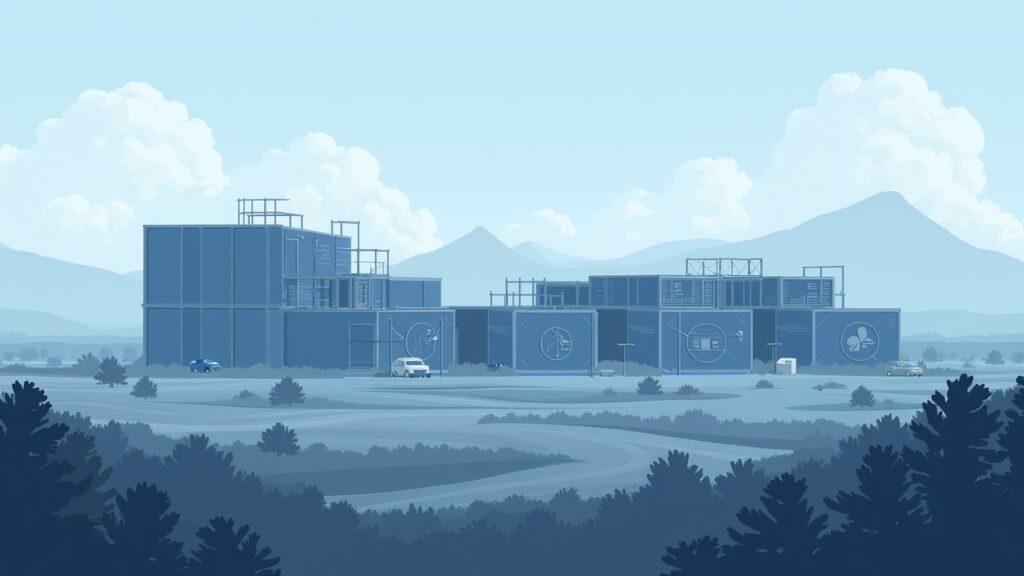
Core Scientific is shifting its business model away from large-scale Bitcoin mining and toward high-density AI data centers, anchored by a planned 1.5 gigawatt expansion at its Pecos, Texas campus. The strategy includes repurposing roughly 300 megawatts of mining power for AI workloads and raising new capital through a proposed $3.3 billion senior secured notes offering.
The pivot reflects a major reallocation of energy infrastructure from crypto mining to AI compute demand. For lenders, energy suppliers, hosting providers and institutional counterparties, the plan changes Core Scientific’s risk profile from mining-cycle exposure to construction execution, tenant concentration and leveraged infrastructure finance.
Financing the AI Infrastructure Buildout
Core Scientific has assembled a multi-part financing package to support the transition. On March 5, 2026, the company announced a strategic financing facility of up to $1 billion with Morgan Stanley and expanded an existing facility with J.P. Morgan to $1 billion.
The company also proposed a $3.3 billion offering of senior secured notes due 2031. Proceeds are intended to fund data-center development across Texas, Georgia, North Carolina and Oklahoma, while also repaying delayed-draw term loans. That structure gives Core Scientific capital for expansion, but it also increases leverage and makes execution timelines more important to future cash flow.
The commercial anchor is a 12-year, $10 billion revenue agreement with CoreWeave. Under the deal, Core Scientific agreed to construct and lease six high-density data centers and committed to a take-or-pay arrangement covering 590 MW of capacity. CoreWeave will provide upfront rent payments to support construction.
That partnership remains central even after Core Scientific shareholders rejected CoreWeave’s previously proposed $9 billion all-stock merger in October 2025. The merger failed, but the operating relationship still underpins the AI data-center strategy.
Pecos Expansion Brings Scale and Concentration Risk
The Pecos campus is expected to scale to about 1.5 GW of gross power capacity, with roughly 1.0 GW designated as leasable capacity for external AI infrastructure clients. As of April 2026, the first data hall had completed foundational work and moved into vertical construction.
Core Scientific expects initial capacity to become available in early 2027 and aims to reach the full 1.5 GW gross power capacity by 2027. Those milestones now matter because construction and commissioning schedules will influence revenue timing, debt-service capacity and counterparty confidence.
The strategy carries two major risk concentrations. The first is construction risk: delays in high-density data halls could push back revenue and strain financing assumptions. The second is customer concentration: CoreWeave represents a material share of contracted capacity, making its performance under the take-or-pay agreement central to the model.
Market reaction has been cautiously positive. Investor sentiment improved in the weeks before April 21, 2026, with Core Scientific’s stock posting year-to-date gains and some analysts raising price targets. That response suggests investors are weighing the AI infrastructure upside against leverage, delivery risk and dependence on a major counterparty.
The key monitoring points are construction progress, CoreWeave contract performance and recovery priority under the secured debt structure. Lenders and counterparties will also need to track notice provisions, commissioning dates and how claims tied to the 2031 notes rank in a stress scenario.
Core Scientific’s outcome will depend on execution through 2027. If the company delivers initial capacity on schedule and fulfills the CoreWeave obligations, the shift could turn its power assets into a stable AI revenue platform. If timelines slip or tenant performance weakens, the same strategy could amplify financial and operational risk for creditors, service providers and counterparties.