

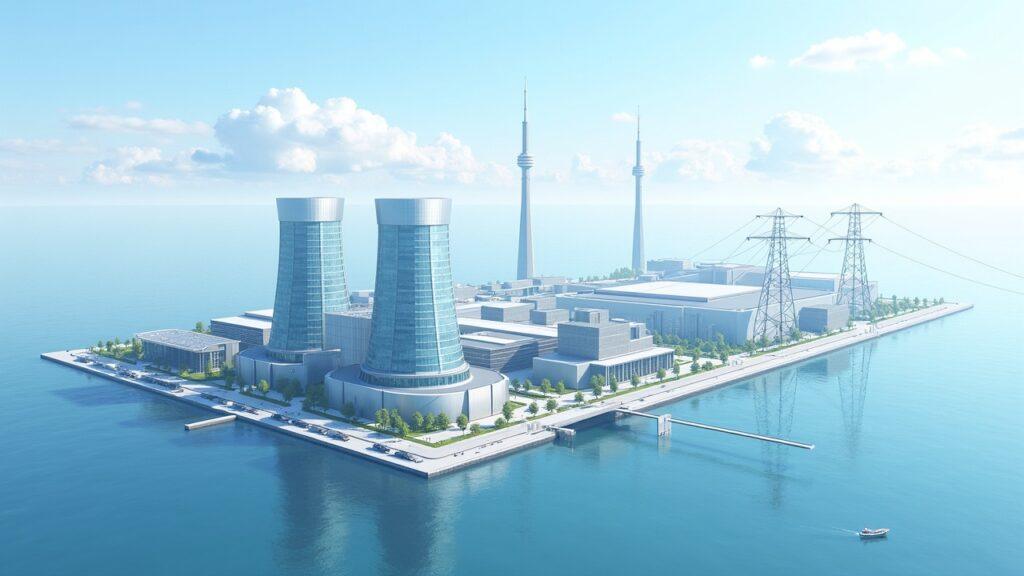
HIVE Digital Technologies announced that its BUZZ High Performance Computing subsidiary acquired roughly 25 acres in the Greater Toronto Area for $58 million, anchoring a planned 320 MW AI infrastructure campus. The project marks a strategic pivot from Bitcoin mining toward large-scale AI compute, with direct implications for power procurement, GPU supply chains and regional grid planning.
The campus is designed to host more than 100,000 GPUs at full build-out and forms part of a broader CAD $3.5 billion investment plan. HIVE said the site includes a 21-acre main parcel acquired for $46 million and an adjacent 4-acre parcel acquired for $12 million, creating a contiguous 25-acre footprint with 320 MW of allocated utility capacity.
AI Compute Replaces Mining as the Growth Engine
The project is targeted to come online in the second half of 2027, placing HIVE’s execution timeline squarely on utility approvals, interconnection progress, construction milestones and GPU procurement. The company said the GTA buildout will expand its global power portfolio beyond 850 MW, including 450 MW already operating and roughly 400 MW in pipeline by 2027.
Executive Chairman Frank Holmes framed the move as industrial infrastructure, saying “AI is the new industrial base and compute is the factory floor.” BUZZ President and COO Craig Tavares described the project as nationally important to Canada’s AI infrastructure buildout, making sovereign compute capacity the central strategic narrative.
The announcement triggered sharp market activity. HIVE shares surged after the news, with market trackers citing gains around 27% to 35% during the session, reflecting a rapid re-rating attempt around AI infrastructure exposure rather than legacy mining economics alone.
Power, Capital and GPU Supply Become the Key Tests
The scale of the buildout creates a material local power-demand issue. A 320 MW allocation for one campus requires coordinated utility planning, grid interconnection work, permitting and potentially negotiated tariff structures before commercial operation can be validated.
Capital intensity is another core execution risk. The CAD $3.5 billion plan is far larger than the $58 million land acquisition, meaning HIVE must convert site control and power allocation into a financed, permitted and equipment-backed data-center development path.
GPU procurement will also determine whether the facility can meet its stated scale. Hosting more than 100,000 GPUs requires long-lead supply agreements, cooling design, networking capacity and operational readiness across multiple vendor and infrastructure layers.
HIVE’s risk profile is changing. The company is moving from Bitcoin mining cyclicality toward data-center construction, power-contract exposure, cooling infrastructure and AI customer-demand risk.
For grid planners, the project represents a concentrated new demand center in the Toronto-Waterloo corridor. The next meaningful signals will be power-delivery milestones, permitting progress, financing disclosures and GPU procurement updates ahead of the 2027 target.