


Key Highlights:
- Crypto exchanges are becoming global brokers by combining crypto, tokenized stocks, and derivatives.
- Tokenized equities offer 24/7 access, but some products do not provide direct share ownership.
- Reliable liquidity, clear ownership rights, and investor protection will determine long-term adoption.
Crypto exchanges built their early appeal around one simple promise: markets that never close. They now apply that model to stocks, funds, and contracts tied to private companies. One account can hold crypto, stablecoins, tokenized stocks, and stock-based derivatives. That mix turns an exchange into something closer to a global broker.
This change does not mean crypto platforms have replaced traditional brokers. Many products provide price exposure rather than direct ownership. Trading rights also differ by country. Yet the direction looks clear. Crypto exchanges want to become the main screen for every tradable asset, at any hour. That model can reduce friction for cross-border users. It can also place familiar labels on products with different rights. The next phase will depend on how clearly platforms explain that gap.
Tokenized Stocks Expand the Exchange Model
RWA.xyz reported $1.86 billion in distributed value across tokenized public equities on July 26.
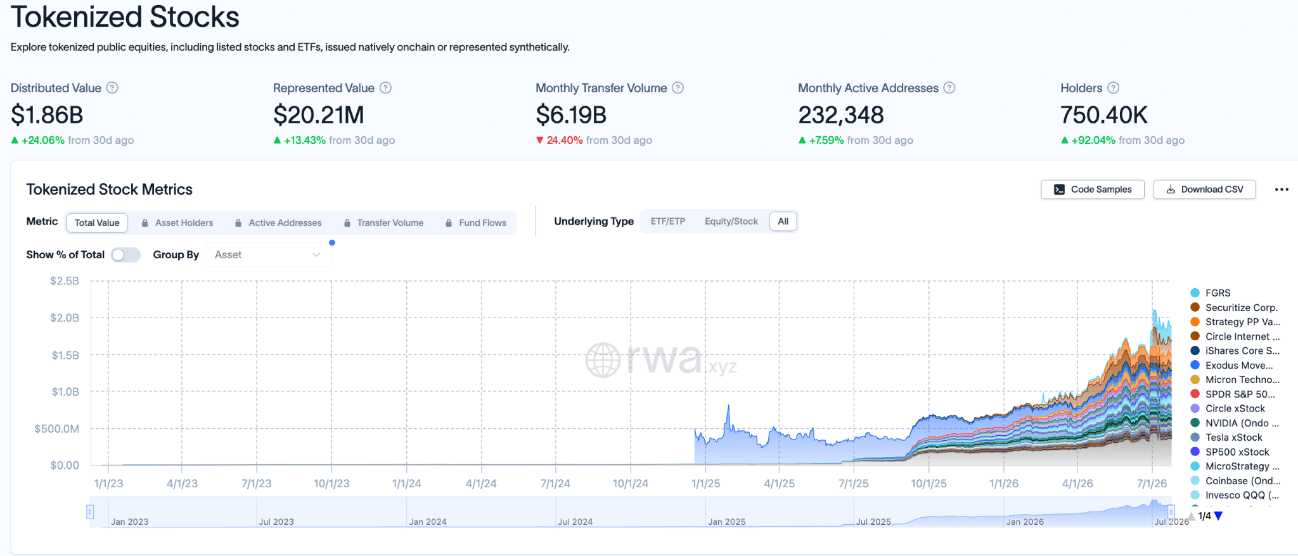
Source: RWA.xyz
Frank Chaparro also shared new market data on X, reporting that monthly on-chain trading volume increased from $117 million in July 2025 to $3.4 billion in June 2026. The market remains small beside traditional equities, but its use has grown fast. Trading volume also shows whether people use these assets rather than simply hold them.
Tokenized stocks are quietly eating the RWA market.
Their share of total RWA market cap has climbed from ~1.4% last July to over 15% today.
Monthly on-chain volume tells the same story: $117M in July 2025 → $3.4B in June 2026. Nearly 30x growth in a year. pic.twitter.com/5P1BhKIt4b
— Frank Chaparro (@fintechfrank) July 11, 2026
The main change sits inside the account. Bitget chief executive Gracy Chen described the design on X on July 15. She said tokenized assets can sit beside crypto and use the platform’s other trading tools. Users can fund positions with stablecoins and move between assets without a bank transfer. That convenience gives exchanges a role once held mainly by online brokers.
The market is already embracing 24/7 trading. We’ve seen more people trading our stock tokens (rToken) on weekends, so clearly Monday morning is losing some of its power 😅
Now that 24/7 access is becoming expected, I think the bigger question is how useful tokenized assets can… https://t.co/vCfFldrJL5
— Gracy Chen @Bitget (@GracyBitget) July 15, 2026
24/7 Trading Turns Access Into the Product
The expansion goes beyond digital copies of listed shares. The Financial Times reported on July 26 that crypto venues now offer contracts tied to Chinese chip companies. Those contracts let users follow a company’s price without owning its shares. Some cover firms or markets that foreign investors cannot easily reach through normal brokerage accounts.
This model sells access before it sells ownership. A perpetual futures contract tracks price and has no expiry date. It does not automatically give voting rights, dividends, or a claim on company assets. Crypto exchanges may look like brokers on the screen, while the legal product acts more like a derivative underneath.
Global Brokers Need More Than Global Reach
Round-the-clock trading also creates a harder market problem. Stocks still publish company news, settle trades, and process dividends through national systems. When the home market closes, fewer traders may set the token’s price. A 24/7 market can stay open while reliable price discovery becomes weaker.
Recent data illustrates that rapid growth has not eliminated liquidity challenges. Kraken’s July 20 research put combined xStocks and Ondo Global Markets assets at $1.273 billion, down from a $1.736 billion peak in June. Strong growth can therefore sit beside fast withdrawals and uneven liquidity. A credible global broker must show clear pricing, redemption rules, custody, and customer rights.
Traditional Markets Are Copying Crypto’s Clock
Crypto platforms already changed expectations across finance. Reuters reported on July 21 that the London Stock Exchange plans to launch LSE 24 in 2027. The venue will start with exchange-traded products and may add stocks later. Nasdaq and Cboe also plan much longer weekday sessions, while CME now trades crypto derivatives every day.
Regulators now treat longer trading hours as a market design question, not a crypto feature. On July 23, the SEC announced a September roundtable on 24-hour equity trading. The agency will examine overnight operations, system strength, and investor protection.
Crypto exchanges will likely become global financial gateways before they become full brokers in every country. Their advantage comes from one account, stablecoin funding, broad access, and an open clock. Still, whether they ultimately function as full-service brokers will depend on ownership rights, market structure, and the regulatory frameworks governing these products, not only on continuous market access.