

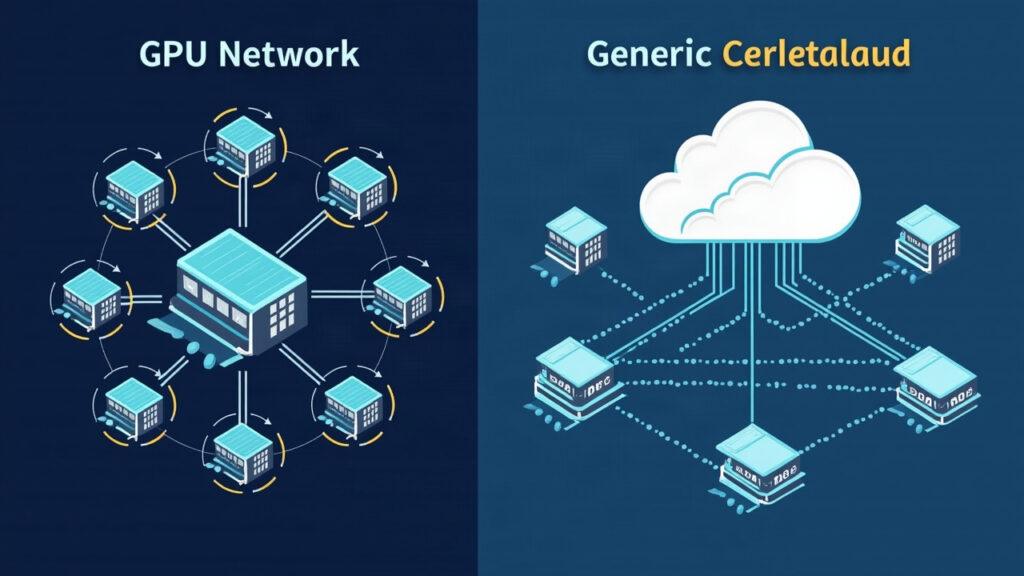
io.net is positioning decentralized GPU infrastructure as a lower-cost alternative to hyperscale cloud providers, claiming that running eight NVIDIA A100 GPUs continuously on its network can save approximately $157,680 per year compared with Amazon Web Services. The comparison centers on identical GPU hardware but sharply different infrastructure pricing models, making cost rather than raw chip capability the main point of differentiation.
In its official 2026 GPU comparison, io.net lists 40GB A100 capacity at an average marketplace price of about $1.90 per GPU-hour, while citing AWS p4d.24xlarge pricing of $32.77 per hour for an eight-A100 instance. The $157,680 figure should be treated as io.net’s own cost comparison rather than an independent benchmark, because actual AWS spending varies substantially with region, commitment structure and purchasing model.
AWS Pricing Shows Why the Comparison Needs Context
AWS independently confirms that its p4d.24xlarge configuration contains eight NVIDIA A100 GPUs with 320 GB of combined GPU memory, matching the hardware class used in io.net’s comparison. The underlying accelerator hardware is therefore broadly comparable, but the surrounding networking, storage, availability and service architecture are not identical.
Pricing is particularly sensitive to how customers buy capacity. Amazon’s official EC2 Capacity Blocks pricing currently lists p4d.24xlarge capacity at an effective $11.80 per hour in several U.S. regions, or $1.475 per A100. That rate is materially below the AWS baseline used in io.net’s headline comparison, demonstrating that the claimed annual saving cannot be applied universally to every AWS deployment.
AWS also offers On-Demand, reserved and other purchasing structures, while io.net operates a marketplace where GPU prices can vary with provider supply. The relevant cost comparison for an AI team therefore depends on workload duration, availability requirements, region and contractual discounts rather than one static hourly rate. AWS describes On-Demand instances as usage-based capacity without long-term commitments, reinforcing how purchasing structure can alter the economics.
Decentralized Compute Competes on More Than Hourly Price
io.net argues that its model can also remove quota delays and egress charges while providing GPU capacity from a globally distributed supplier network. Those features can be attractive for experimentation and cost-sensitive AI workloads, particularly when developers need access to GPUs quickly without long-term cloud commitments.
The trade-off is that AWS provides infrastructure features that decentralized marketplaces may not replicate directly, including tightly integrated storage, high-performance networking, mature enterprise controls and large-scale GPU clusters. Lower compute pricing does not automatically mean equivalent operational performance or enterprise suitability, especially for workloads requiring predictable inter-GPU networking, compliance certifications or deep integration with other cloud services.
The io.net comparison highlights a genuine competitive pressure in AI infrastructure: access to the same class of GPU can carry very different commercial economics depending on how compute is sourced. The $157,680 saving is best viewed as a company-specific scenario showing the potential advantage of decentralized GPU markets, not a guaranteed annual saving against every AWS pricing option.