


TL;DR
- Bitcoin fell nearly 4% after the CLARITY Act failed, but recovered to $80,000 within a few days, and the crypto market followed suit.
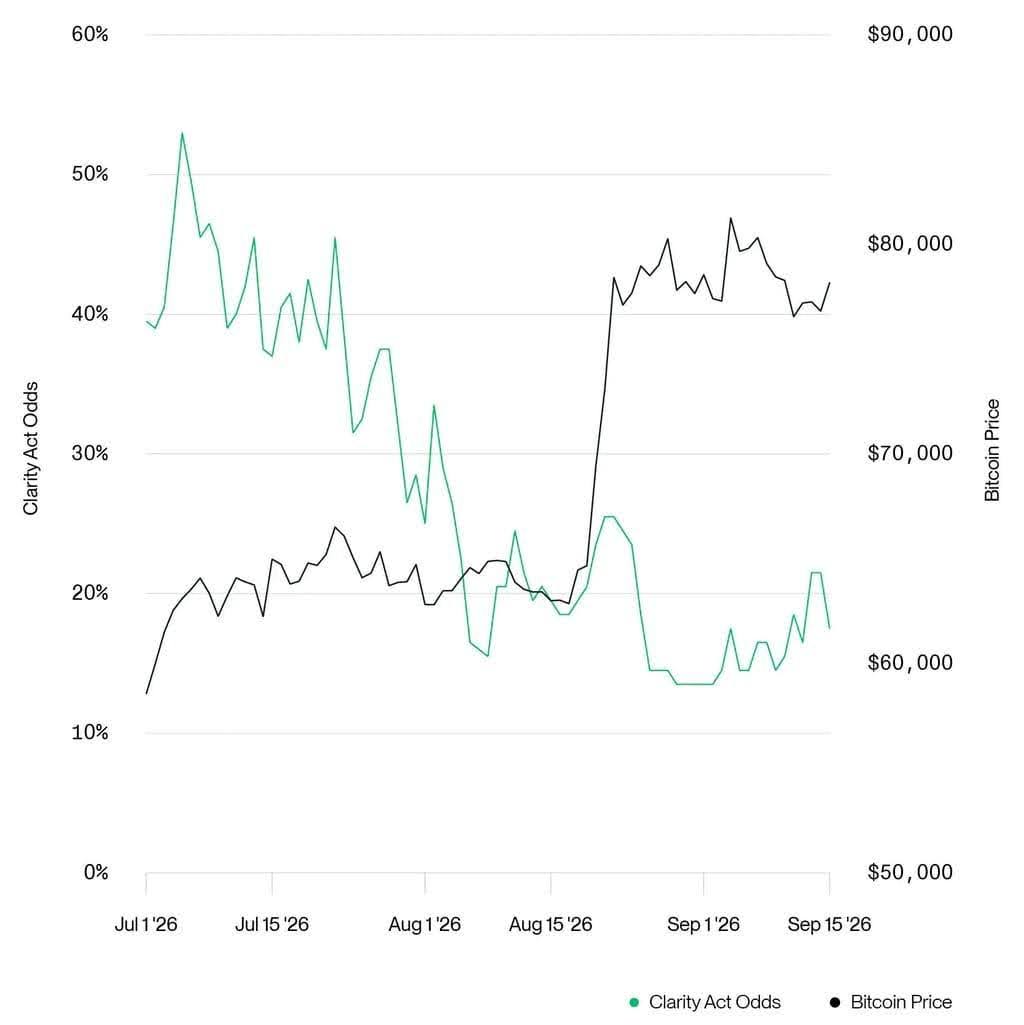
- According to Polymarket, the project’s chances of approval had already dropped from 39% to 18%. Meanwhile, the price of BTC was rising.
- The crypto market seems to distinguish between law and regulation by agencies, although the risk of reversal remains open.
For years, every regulatory development in the United States acted almost like a switch for the crypto market: an approval sparked optimism and a rejection triggered sell-offs. An analysis of what happened over the past week suggests that binary logic is losing its grip.
On September 15, the CLARITY Act, the most ambitious market structure bill the industry had, failed to advance in the Senate. It needed 60 votes and received only 49. Bitcoin fell nearly 4% that day. Yet by September 18 it was already posting a 5.5% gain in 24 hours, reaching $80,822, according to CoinGecko.
The speed of the recovery does not fit the classic playbook, in which a legislative defeat of this magnitude should weigh on prices for weeks.
The CLARITY Act’s Failure Was Already Priced In
Matt Hougan, Chief Investment Officer at Bitwise, presented his analysis and provided revealing data. Between July 1 and September 4, Bitcoin moved from $57,950 to over $80,000. During that same period, the probability Polymarket assigned to the bill passing that year dropped from 39% to 18%. If the bull market depended on the legislation, he argues, the decline in those odds would have dragged prices down. The opposite happened.
In other words, the crypto market was pricing in the failure gradually, and the final outcome became known with much of the adjustment already done. Moreover, major firms did not sit around waiting for Congress: Robinhood launched its own blockchain, Morgan Stanley a Solana ETF, and the DTCC settled its first transactions with tokenized shares.
Hougan attributes that confidence to an SEC and a CFTC that appear and act more favorably toward the crypto market. The SEC proposed in August its Regulation Crypto Assets, the CFTC chair, Mike Selig, claims to have its rules ready, and SEC chair Paul Atkins stated on September 16 that the agency will continue developing rules under its current authority. Regulation did not disappear: it changed its source.
The Crypto Market Distinguishes Between Probability and Surprise
While this rebound is not definitive proof of greater sophistication in the crypto market, it does allow us to shed light on a significant structural change. The Federal Reserve raised the rates 25 basic points from 3.75% to 4.00%, on September 16, but it was a widely supported movement earlyTherefore, its impact was considerably limited.
Furthermore, despite $507 million in liquidations being recorded in a 24-hour period, some $449 million, near the 89%, corresponded to short positions. A rebound driven by the forced closure of bearish bets. It may have more to do with technical mechanics than with risk reassessment.
Hougan acknowledges the limitations of his analysis: the rules of the agencies can be reversed with a new administration. And only Congress can give it to the CFTC real authority over spot markets. That’s the risk that the crypto industry still doesn’t seem to fully cover.
The crypto market has not become immune to politics, but rather processes it with more nuances. It distinguishes between probability and surprise, and between law and regulation. The real test will come when the SEC and the CFTC publish rules and with a change on the political sign in Washington. Then we’ll know if what we saw was maturity or just a good moment.