


Bitcoin liquidity remains under pressure as high Treasury yields, dollar strength, and institutional ETF withdrawals challenge the cryptocurrency’s improving macroeconomic narrative. Although concerns about currency depreciation support Bitcoin’s long-term investment case, financial conditions continue to restrict risk appetite.
Recent market data suggest that changing Federal Reserve expectations have not delivered broader relief across funding markets. Meanwhile, persistent exchange-traded fund outflows indicate weaker demand for Bitcoin through these investment products, even as institutional access remains available.
The divergence comes as investors assess Bitcoin’s fixed supply against rising government borrowing costs. Its maximum supply of 21 million coins supports the currency-depreciation argument, but market prices still depend on available demand. Consequently, monetary concerns and tighter financing conditions can influence Bitcoin through competing channels.
Bitcoin Liquidity Faces Pressure From High Treasury Yields
U.S. Treasury yields remain central to the market’s funding challenges. According to CoinShares’ October 8 assessment, the 10-year Treasury yield surpassed 5.3%, while the 30-year yield reached 5.7%. These figures should be understood in the context of the assessment’s measurement period rather than assumed to represent current yields or closing levels on a particular date.
Higher yields increase financing costs and provide income-generating alternatives to assets without contractual returns. They can also affect leveraged investors who rely on borrowed capital to maintain market exposure.
However, changing Federal Reserve expectations have not eliminated those pressures. CoinShares reported that the estimated probability of an October rate hike fell from 71% to 23% within three weeks. The figures reflect changing market expectations, not a guarantee of the Federal Reserve’s eventual decision.
The repricing followed weaker September employment figures, which changed expectations for monetary policy. Nevertheless, reduced expectations of further tightening do not directly increase available funding or guarantee lower long-term borrowing costs.
Meanwhile, fiscal concerns create another complication. Rising government borrowing requirements can strengthen arguments about currency depreciation while also placing upward pressure on Treasury yields.
These changes leave Bitcoin exposed to competing forces, even as its monetary narrative draws attention.
Institutional ETF Withdrawals Outline Weakening Demand
Institutional investment flows provide another measure of Bitcoin’s near-term market conditions. U.S. spot Bitcoin ETFs recorded approximately $774.3 million in combined net outflows across six sessions ending October 12, according to the cited market data.
According to Bitbo data, October 7 recorded the largest withdrawal during that period, totaling approximately $348.8 million. The figures followed earlier institutional inflows and indicated net selling through these listed investment products during the sessions examined.
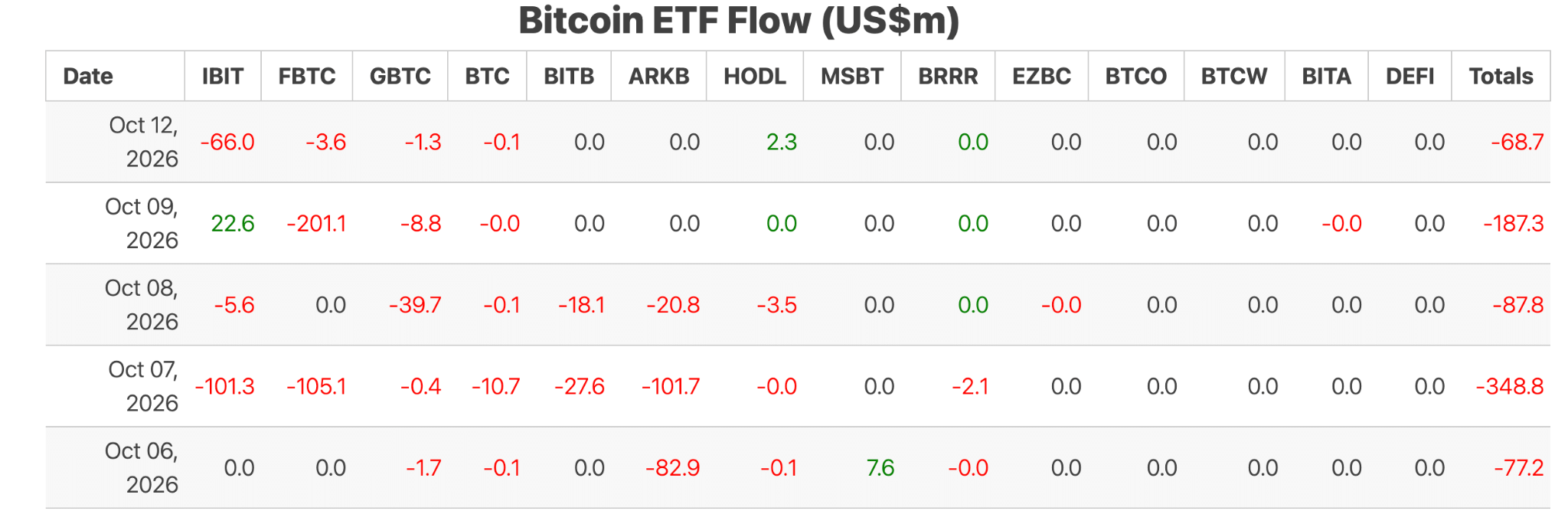
Source: Bitbo
However, ETF withdrawals do not capture every institutional transaction. Direct purchases, corporate holdings, and private-market activity are not reflected in those figures. The outflows therefore indicate weaker demand through the ETFs covered, but do not establish that institutional demand across the entire Bitcoin market has declined by the same amount. This distinction matters when high bond yields compete for portfolio allocations.
Dollar strength has also complicated the investment environment. Fidelity Digital Assets reported that the Dollar Index had risen approximately 5% since Bitcoin’s October 2025 peak. A stronger dollar can increase acquisition costs for investors using other currencies and influence international financing conditions, although its effects on Bitcoin depend on broader market circumstances.
Global Money Supply Growth Has Not Restored Momentum
Fidelity Digital Assets’ August research identified another divergence between Bitcoin and broader monetary conditions. Its historical analysis found a 0.86 correlation between Bitcoin and global M2 money supply over the period examined.
However, the rolling 24-month relationship later turned negative despite continued monetary expansion. The findings suggest that broader money supply growth has not consistently coincided with higher Bitcoin prices. Correlation alone, however, does not establish that changes in M2 cause Bitcoin prices to rise or fall.
Fidelity also examined dollar strength, financing conditions, and capital allocation toward artificial intelligence infrastructure as possible explanations for the divergence. Separately, Federal Reserve Bank of Chicago research identified increasing Bitcoin sensitivity to U.S. equity-market movements over time.
Together, these findings highlight the difference between monetary expansion and capital flowing into crypto markets. Treasury yields, credit conditions, dollar movements, and ETF flows therefore remain relevant indicators of Bitcoin’s funding environment, although none independently determines its price trajectory.