

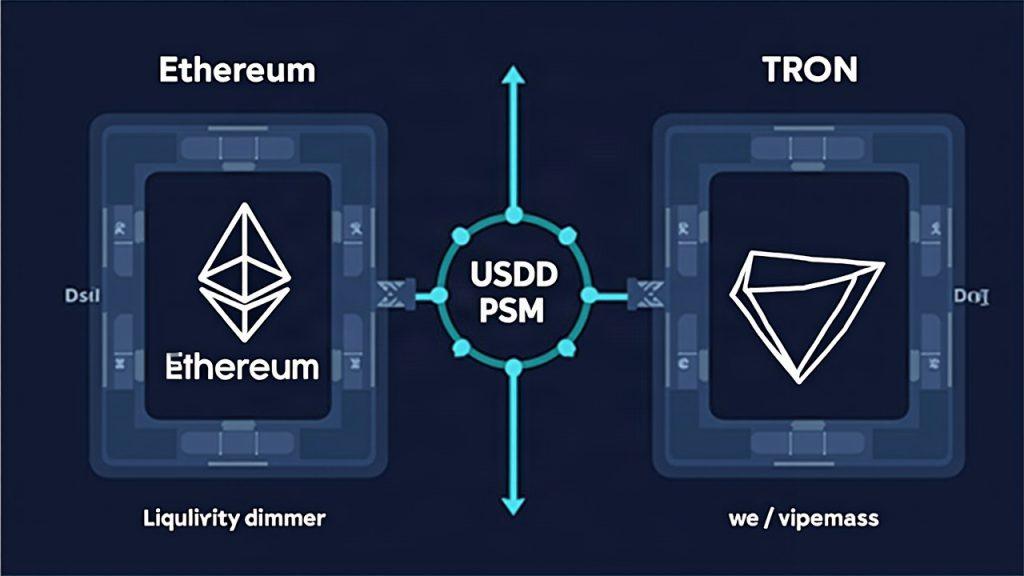
USDD’s Ethereum Peg Stability Module currently holds more than 100 million USDT available through its stablecoin-conversion infrastructure, showing a materially different position from a liquidity shortage reported earlier this year. According to USDD’s official contract directory, the Ethereum USDT PSM routes reserves through an adapter that currently holds approximately 100.7 million USDT. The separate USDC adapter, however, has almost no USDC balance, making liquidity dependent on both the chain and the stablecoin selected for redemption.
The distinction corrects an outdated signal from April 20, when USDD said liquidity in its Ethereum PSM was temporarily “lower than usual” and would be replenished through standard procedures. At the time, the project said TRON and BNB Chain remained sufficiently funded. Current on-chain balances no longer reflect that April Ethereum liquidity condition, so the old notice should not be interpreted as evidence of present stress.
PSM Liquidity Depends on the Redemption Asset
USDD’s PSM provides fixed-rate conversions between USDD and supported stablecoins rather than relying on an automated market maker’s pricing curve. The official PSM documentation describes conversions at a 1:1 rate without swap slippage, although users still incur blockchain transaction costs. When a user exchanges USDD for a supported stablecoin, the amount available depends on reserves accessible through that specific PSM route.
Ethereum currently supports both USDT and USDC pathways. The USDT adapter holds roughly 100.7 million tokens, while the USDC adapter is effectively empty. A large USDT redemption can therefore face a very different liquidity ceiling from an equivalent USDC redemption even though both operate under the same Ethereum deployment. That makes aggregate descriptions such as “Ethereum PSM liquidity” less precise than examining each underlying reserve asset.
TRON operates a separate USDT PSM and remains the primary network for USDD activity. Its reserve adapter has recently held around $20 million in USDT while continuing to process fixed-rate swaps. The network also hosts the majority of USDD supply, consistent with the broader concentration visible in The Chain Observer’s stablecoin supply and peg monitor. Chain-level supply, however, is not the same metric as PSM redemption capacity, because only assets allocated to the module provide immediate fixed-rate conversion liquidity.
PSM Reserves Are Only One Part of USDD Backing
The PSM should also be separated from USDD’s broader collateral structure. The protocol uses vault collateral and a Smart Allocator alongside stablecoins held for direct conversions. A reduction in one PSM balance does not automatically mean USDD has lost an equivalent amount of backing, just as a high module balance does not by itself establish stronger overall solvency.
The distinction is similar to other stablecoin metrics that can appear interchangeable but measure different functions. A large USDT mint on TRON represents token creation rather than immediate circulation, while millions of dollars deposited into an OUSD trading pool measure secondary-market liquidity rather than issuer redemption reserves. PSM balances instead measure the stablecoins directly available through USDD’s fixed-rate conversion mechanism.
USDD itself continues trading close to its dollar target, while its PSM contracts remain operational across TRON, Ethereum and BNB Chain. The relevant current signal is not an unresolved Ethereum liquidity shortage, but an uneven distribution of redemption capacity across individual PSM assets and networks. Monitoring those balances separately provides a more accurate picture of how much fixed-rate liquidity USDD can supply at any particular moment.