

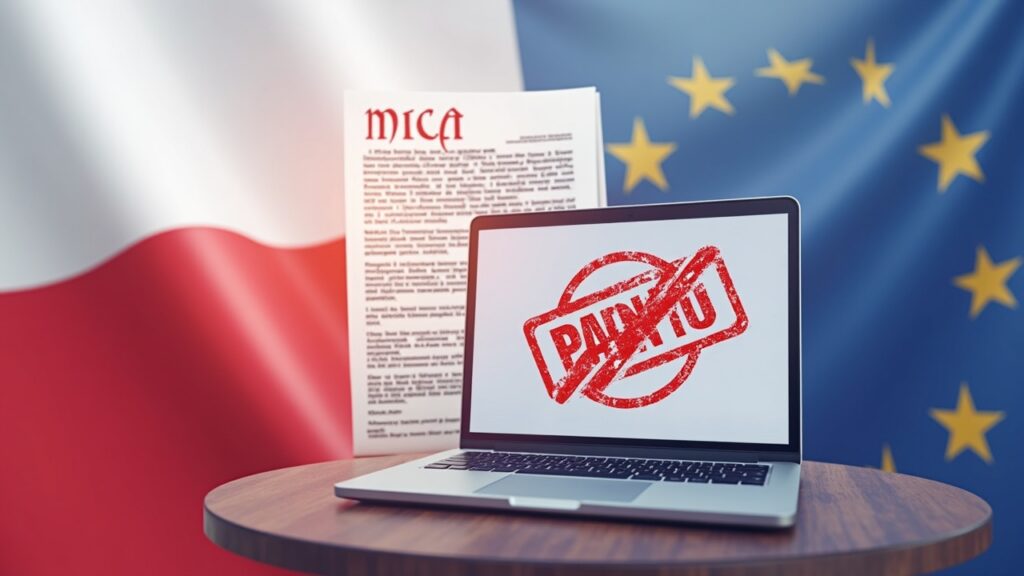
Poland’s president vetoed the domestic implementation of the EU MiCA framework, arguing that the draft law threatened the “freedoms of Poles” and could be misused by regulators, a move that immediately created a regulatory gap preventing Polish crypto firms from obtaining the authorizations required to operate across the EU.
A veto driven by concerns over overreach and regulatory abuse
The presidential veto focused on several contentious measures, especially a domain-blocking mechanism granting the Polish Financial Supervision Authority (KNF) unilateral power to disable crypto-company websites. The presidential office warned that “domain blocking laws are opaque and can lead to abuse,” framing the mechanism as a risk to property rights and free economic activity. The draft bill—over 100 pages—also proposed a KNF-run blacklist of “forbidden domains,” banking-style sanctions, steep administrative fines, and mandatory licensing rather than simpler registration for many crypto service providers.
MiCA—the EU’s Markets in Crypto-Assets regulation—is intended to harmonize crypto-asset rules across member states, but critics argued that Poland’s draft “gold-plated” the framework by adding complexity beyond the EU text, contrasting it with shorter and more streamlined implementations in neighboring jurisdictions.
Industry commentary also cited the KNF’s slow authorization history—typically 20–24 months for payment institutions and just one e-money license issued in a decade— arguing that such delays are incompatible with the speed of crypto markets and strengthened the president’s case for rejecting the bill.
The veto leaves domestic firms unable to secure national MiCA authorization, a prerequisite for offering services across the EU, and creates a competitive advantage for non-Polish providers. Industry voices warned of flight of capital, talent, and tax revenue, with one CEO calling the government’s position evidence of national “backwardness.”
Political reactions split sharply. Finance Minister Andrzej Domański warned of market “chaos and a vacuum,” claiming the veto weakens consumer protection and noting that “20% of clients are losing their money” due to market abuses. Supporters of the veto countered that enforcement should target bad actors directly instead of imposing broad regulatory burdens that could push companies abroad.
President Karol Nawrocki’s decision also reflects broader political tensions: aligned with the Law and Justice (PiS) party, he has repeatedly clashed with Prime Minister Donald Tusk’s government, and has used his veto against several pieces of coalition-backed legislation. Options now include a parliamentary override requiring a three-fifths majority or a narrower, revised bill more closely aligned with MiCA’s core text.
The veto injects near-term legal uncertainty into Poland’s crypto market and raises the likelihood that firms will relocate to other EU jurisdictions with functioning MiCA frameworks.