

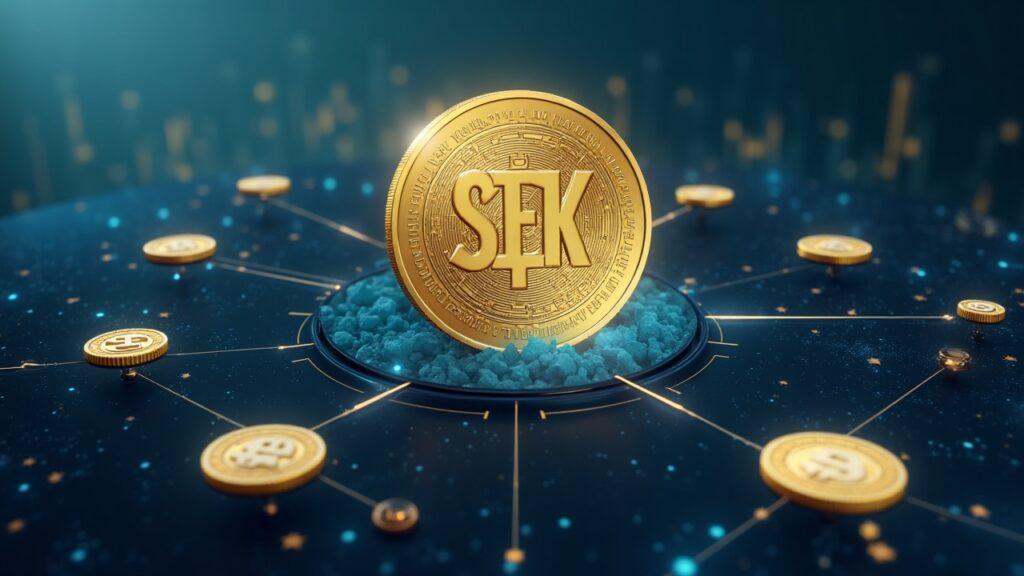
AllUnity has launched SEKAU, a Swedish krona-backed stablecoin structured as a fully reserved e-money token under MiCAR. The company said the token is pegged 1:1 to the Swedish krona and backed by segregated reserves.
The rollout adds a new local-currency stablecoin to a market increasingly shaped by regulated issuance and jurisdiction-specific payment needs. Rather than extending only dollar-based rails, AllUnity is positioning SEKAU as a krona-denominated instrument for institutional settlement and digital asset markets.
SEKAU Expands AllUnity’s Regulated Token Lineup
AllUnity said SEKAU is designed for institutional settlement, cross-border payments and digital asset market activity. The token is available through the company’s business mint account, with additional trading venues expected to follow.
⛓️ #EURAU Goes Live on @BNBCHAIN
We are excited to announce that #EURAU, our fully regulated and MiCA-compliant Euro stablecoin, is now live on BNB Smart Chain.
This launch brings trusted Euro liquidity to one of the world’s most active ecosystems, enabling seamless, low-cost… pic.twitter.com/yABu3C2kBQ
— AllUnity (@AllUnityStable) May 27, 2026
The launch also fits into AllUnity’s broader digital-money framework. SEKAU is being introduced alongside EURAU and CHFAU, giving the company a growing set of currency-specific stablecoins backed by regulated reserve structures.
That strategy reflects a more regionalized stablecoin model. Instead of relying on a single global token for all use cases, AllUnity is building separate fiat-backed instruments for different settlement markets.
According to material surfaced from AllUnity’s official account, the SEKAU launch begins on June 19, 2026, with availability across several chains, including Ethereum, Solana, Base and Polygon. However, live usage at scale has not yet been independently confirmed.
Adoption Metrics Still Need Confirmation
The key distinction is between product availability and real market adoption. A regulated stablecoin can launch with reserve backing and mint access, but circulation, liquidity and transaction volume still need to develop over time.
SEKAU’s MiCAR structure may make it more relevant for institutions seeking compliant local-currency settlement rails. That could matter for payments, treasury operations and trading venues that want krona exposure without relying entirely on bank transfers.
Still, the available materials do not yet provide a detailed breakdown of circulating supply, transaction activity or exchange liquidity. Those figures will be necessary to evaluate whether SEKAU becomes a meaningful settlement asset or remains an early-stage issuance product.
For now, the confirmed development is clear: AllUnity has launched a fully reserved Swedish krona stablecoin, positioned it under MiCAR and added it to its existing regulated token lineup. The next test will be how quickly SEKAU expands beyond initial mint access into active market use.