

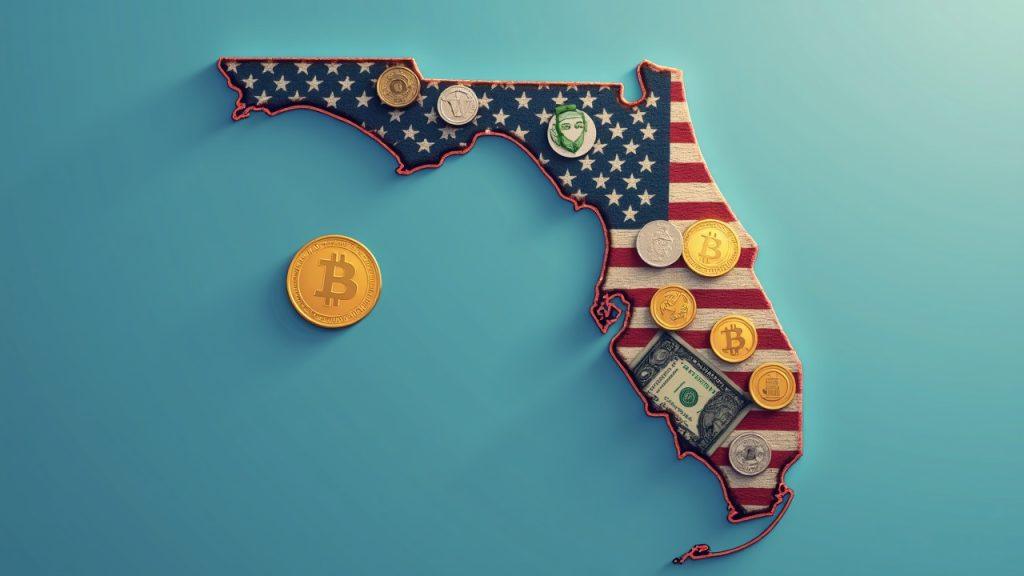
Florida is moving to put payment stablecoins under a formal state regulatory regime after lawmakers approved Senate Bill 314, sending it to Governor Ron DeSantis for consideration. The bill cleared both chambers unanimously in early March 2026 and, if signed, would take effect on October 1, 2026. The measure is designed to bring stablecoin issuance inside a clear licensing and supervision framework rather than leaving it in a gray area between payments law and crypto regulation.
At its core, SB 314 is Florida’s attempt to treat payment stablecoins as a regulated financial product with defined reserve, custody, and compliance standards. That matters because it gives issuers, counterparties, and public agencies a more predictable rulebook while also raising the operational bar for anyone wanting to do business in the state.
BITCOIN HISTORY WAS JUST MADE IN FLORIDA
We are now the FIRST STATE to Pass a Stablecoin framework in the nation!
It has now passed the Senate and the House, and will be signed by DeSantis within the next 30 days!
How was this able to happen? Well, because we are literally… pic.twitter.com/KA3odWMPzA
— Samuel Armes (@samuelarmes) March 6, 2026
Florida is building a state-level rulebook for stablecoin issuers
The bill places primary oversight in the hands of the Office of Financial Regulation, which would become the main state regulator for stablecoin issuers, with some overlap where federal banking supervision already applies. That structure makes clear that Florida is not waiting for Washington to settle every open question before building its own compliance perimeter.
SB 314 also amends the state’s money services laws so that stablecoin issuance sits under existing financial controls instead of outside them. In practical terms, that means issuers would need to operate more like licensed financial firms than lightly supervised crypto businesses. The state is effectively saying that if a token is meant to function like money, then the issuer has to meet money-like regulatory standards.
Reserve, AML, and yield rules sit at the center of the bill
One of the most important provisions is the reserve requirement. The bill says qualified payment stablecoins must be backed 1:1 by cash or U.S. Treasuries, a standard meant to reduce solvency concerns and strengthen confidence in redemption. That reserve rule turns treasury management into a central compliance issue, not just a back-office function.
The legislation also folds stablecoin issuers into Florida’s anti-money-laundering framework. Issuers would have to comply with AML and KYC rules under the state’s Control of Money Laundering in Money Services Business Act, and transactions above $10,000 would need to be recorded. That means the stablecoin business model would carry the same kind of monitoring and reporting obligations already familiar to other licensed money-services operators.
The bill tries to reduce classification uncertainty while still drawing limits. It states that certain payment stablecoins will not be treated as securities, but it also bars issuers from offering interest or yield where federal law already restricts those features. Florida is trying to make room for payment-focused stablecoins while avoiding the more legally sensitive territory around yield-bearing products.
The law could also turn Florida into a public-sector testing ground
SB 314 goes beyond issuer licensing and private-market use. It would allow the Florida Department of Financial Services to accept approved stablecoins for state payments and authorizes a pilot program to study how stablecoins could be used in government operations. That gives the bill a practical dimension: it is not only about supervising issuers, but also about testing whether stablecoins can function inside real public-sector payment flows.
A companion measure would also strengthen confidentiality protections for nonpublic business information collected by regulators from virtual currency firms and stablecoin issuers. That may sound technical, but it matters to companies that worry about how much sensitive operational data they must hand over once licensing begins.
Industry expectations are that the governor will act soon. Samuel Armes of the Florida Blockchain Business Association said he expects the bill to be signed within 30 days. If that happens, firms would have a short runway before the October effective date to adjust reserves, custody structures, compliance programs, and reporting systems. The window is long enough to prepare, but short enough that firms cannot afford to wait for the last minute.
The bigger message is that Florida wants stablecoins inside a regulated payments lane
Florida’s approach is notable because it tries to reduce legal uncertainty without abandoning strict operational requirements. The bill fits conceptually alongside federal stablecoin efforts, including broader harmonization discussions tied to national proposals, but it also shows that states are willing to move first when they see a gap. For issuers and counterparties, that means market access will increasingly depend on proving operational discipline, not just offering a useful token.
Florida is creating a defined framework for who can issue payment stablecoins, how reserves must be held, and what reporting and AML obligations come with that privilege. If the governor signs SB 314, the state will become one of the clearest examples of how stablecoins can be brought into a regulated payments system without waiting for a single federal answer to every open question.