

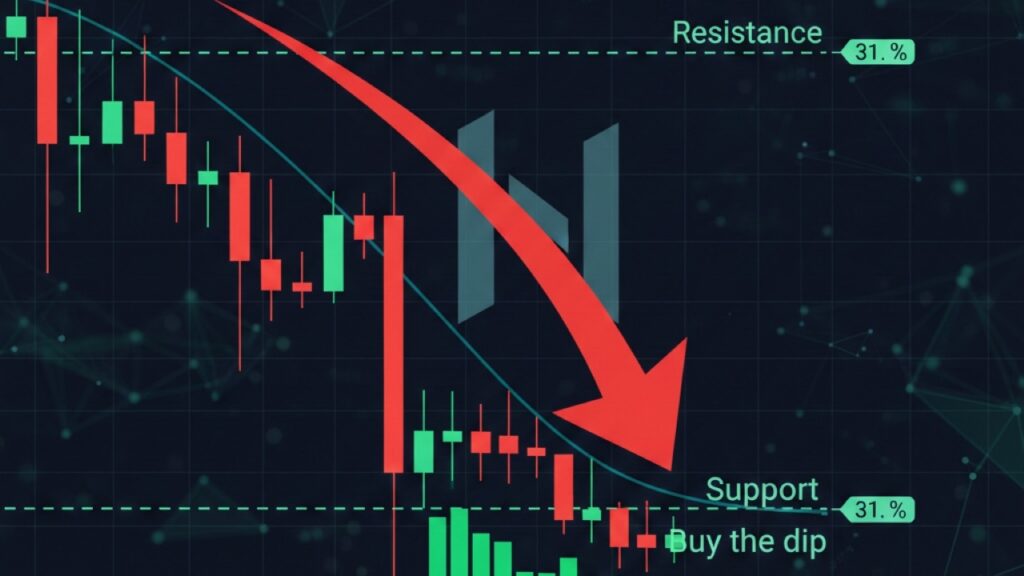
HBAR is carrying elevated downside risk, with a potential 31% decline as technical indicators and market positioning soften its near-term outlook. Episodic dip buying is trying to steady price action, but a bear-flag breakdown, weak spot flows, and a derivatives market tilted toward shorts keep the overall structure fragile.
The short-term trend is defined by a confirmed bear-flag breakdown, a continuation pattern that typically points to further downside once the “neckline” gives way. The Money Flow Index (MFI) remains weak despite occasional bullish-divergence attempts, and spot buying has reportedly collapsed in some measures by as much as 90%, leaving selling pressure in control and sentiment leaning toward fear.
Key levels that can validate or unwind the bearish setup
Near-term direction is now threshold-driven, with clear levels doing more work than narratives. A break beneath the bear-flag neckline would validate the continuation pattern and open the door to lower supports, with some shorts treating one support area as the last meaningful line before the 31% downside target becomes much more likely. On the upside, a reclaim of immediate resistance is required to relieve pressure. If successive higher resistance levels are reclaimed, they would progressively erode the flag structure until a decisive invalidation flips the bias away from the bearish case.
Large-holder behavior and flow signals complicate the picture rather than resolve it. Some top addresses are described as remaining net long, consistent with strategic accumulation, while derivatives positioning over the last 30 days is said to skew heavily toward shorts, creating a clash between long-horizon accumulation and short-horizon bearish bets. That divergence increases volatility risk, especially if either cohort changes posture quickly.
Derivatives skew is the accelerant, while spot demand is the missing ingredient
Derivatives imbalances and elevated short interest amplify downside risk by turning selloffs into faster moves. Liquidation cascades can accelerate price declines when positioning is crowded, which is why the current short-heavy skew increases the probability of sharp downside extension. There is a limited stabilizing counterweight. Reduced short-selling pressure and persistent long positioning in large wallets can provide some support, but buyer activity is still described as too light in both volume and conviction to reliably overpower the broader bearish structure.
With sentiment in “fear” territory, the near-term approach is tactical and conditional. Rallies are best treated as potentially transient until robust buying volume clearly returns, because dip buying only matters if it becomes sustained, high-volume accumulation. If that kind of demand shows up, the setup can change. If meaningful spot demand fails to materialize, the breakdown scenario remains the base case.
Risk management has to match the structure. Clear technical thresholds and elevated derivatives exposure make position sizing and disciplined stops the priority rather than aggressive directional conviction. The immediate outlook ultimately comes down to the same variable. If buying volume cannot outmatch prevailing selling pressure and short positioning, the technical setup continues to favor a material downside.