

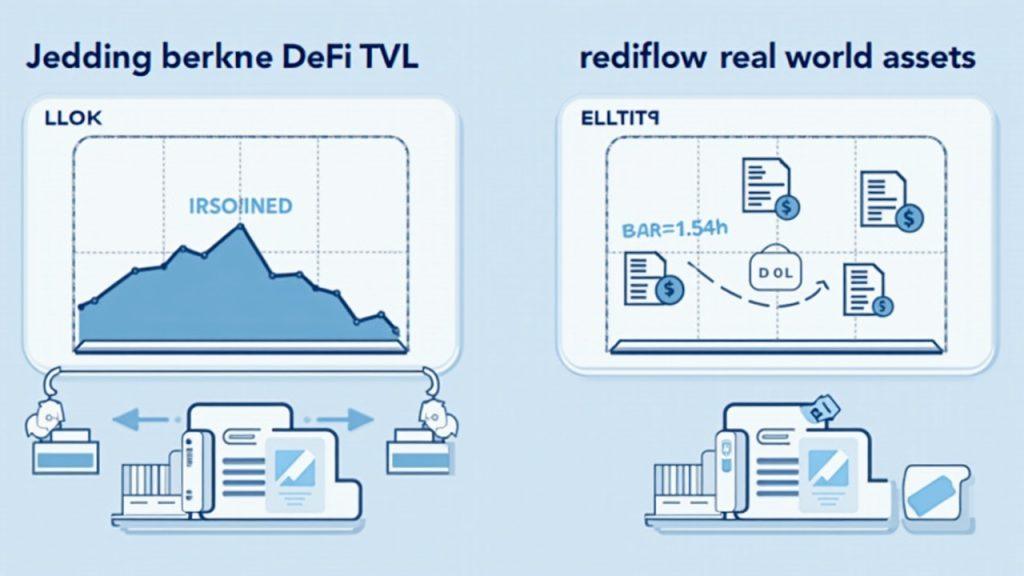
Institutional and risk-averse capital is rotating away from high-beta DeFi exposure toward tokenized real-world assets (RWAs) as of February 2026. The shift is being framed as a reallocation of on-chain liquidity toward instruments perceived as more predictable under current market conditions.
The data through February 2026 shows DeFi TVL falling about 25% to $94.84 billion while tokenized RWAs rose 8.68% to $24.84 billion. In practical terms, the numbers point to a measurable divergence between speculative on-chain risk appetite and demand for asset-backed exposure.
What’s Driving the Rotation
Market commentary links the move to a broader risk-off posture tied to macro uncertainty and rising benchmark yields. That environment has pushed allocators to prioritize capital preservation and downside control over higher-variance return profiles.
DeFi yield compression is described as reducing the incentive to deploy liquidity into lending and staking, reinforcing the TVL drawdown. As yields tighten, the value proposition of high-beta DeFi positions becomes harder to justify for conservative mandates.
RWAs are positioned as more institutionally legible because they emphasize predictable cash flows and legal enforceability over token-emissions-driven returns. Within the same reporting set, tokenized U.S. Treasury exposure is cited as up 10% to $10.7 billion, commodities tokenization up 20% to $6.9 billion, and private credit up 15% to $2.9 billion, while Aave Horizon is reported to have crossed $1 billion in RWA deposits.
Operational Implications
Growing RWA allocations shift custody expectations toward segregated custody and tighter reconciliation between on-chain tokens and off-chain assets. This increases the operational burden to maintain a clean linkage between token balances and the underlying legal claims.
Compliance and record-keeping requirements rise because institutional demand is tied to verifiable rights, documented cash flows, and audit-ready workflows. Teams should expect heavier emphasis on mapping beneficial ownership to asset provenance and maintaining documentation that supports process audits.
Counterparty and valuation governance becomes more central as firms adapt to enforceability, valuation transparency, and broader institutional control standards. If the rotation continues at scale, the immediate execution priority is to harden the operational and legal framework that supports RWA issuance and custody.