

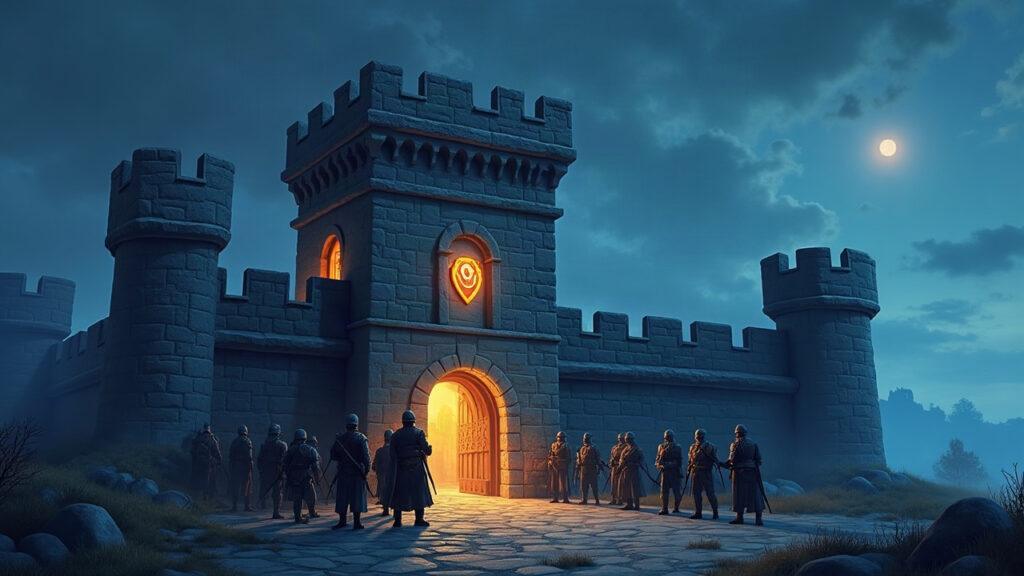
Stonewatch has gone live on Robinhood Chain, introducing a browser-based strategy game built around kingdom expansion, armies and an in-game $SW economy. The project’s public launch announcement tells users to build a kingdom, gather an army and begin earning the token, while the official Stonewatch guide describes $SW as the sole currency used across the game. The release adds a gaming application to Robinhood Chain’s growing mix of trading, token and NFT activity rather than another purely financial protocol.
Stonewatch follows an idle-strategy model. Players connect an EVM wallet, establish a kingdom and use buildings such as the Keep, Barracks, Armoury and Granary to develop their army. Soldiers standing in a player’s garrison produce $SW hourly, including while the player is offline. $SW production comes from gameplay mechanics rather than staking, meaning the advertised “earning” mechanism is tied to maintaining and upgrading an in-game army.
$SW Connects Gameplay With an Onchain Vault
New kingdoms receive starter resources that include three Pawns and 1,000 $SW, according to the project documentation. Players can spend the token on buildings, soldier ranks and other progression before claiming accumulated production. Withdrawals move $SW from the game vault to the connected wallet and normally carry a 5% fee, with the first withdrawal becoming available 12 hours after settlement. The same $SW functions both as an internal game resource and as a transferable Robinhood Chain token.
Stonewatch says production is server-authoritative, while withdrawals use an onchain vault and signed claims. That architecture means not every game action is independently executed as an onchain transaction even though the resulting token can move to a user-controlled wallet. The project has also integrated Rovyn to enable $SW trading from within its interface. Stonewatch should therefore be described as a hybrid onchain game rather than a system in which every gameplay state change is executed directly by Robinhood Chain.
That model arrives as Robinhood Chain expands beyond tokenized financial products. The network has already recorded swaps, NFT mints and secondary-market activity across multiple application categories, while OpenSea has added Robinhood Chain assets to its marketplace infrastructure. Stonewatch extends that application mix into gaming, where token demand depends on player retention and in-game spending rather than financial trading alone.
Live Game Still Needs Usage Data
There is one qualification around the rollout. Stonewatch’s social account describes the game as live, and its public interface exposes kingdom, army, claim, deposit, duel and raid functions. However, the project’s current guide still displays the message “Season one opens soon.” The available evidence confirms a live application and token economy, but the documentation does not yet provide a fully consistent description of Season One’s rollout status.
The launch also benefits from existing token-market infrastructure on Robinhood Chain. Uniswap has already developed Robinhood-specific liquidity and token-launch infrastructure, while other venues continue expanding liquidity mechanisms across the network. The existence of that infrastructure makes $SW tradable, but it does not establish that Stonewatch will develop a sustainable player economy. Gameplay retention, active kingdoms, token production, withdrawals, burns and secondary trading remain separate metrics.
For Stonewatch, the next meaningful milestone is therefore measurable participation rather than the launch announcement itself. Sustained active players, functioning withdrawals and continued in-game consumption of $SW will show whether the kingdom-building economy can maintain activity beyond its initial release. Clarification from the project on the formal opening of Season One would also resolve the remaining discrepancy between its live interface and current guide language.