

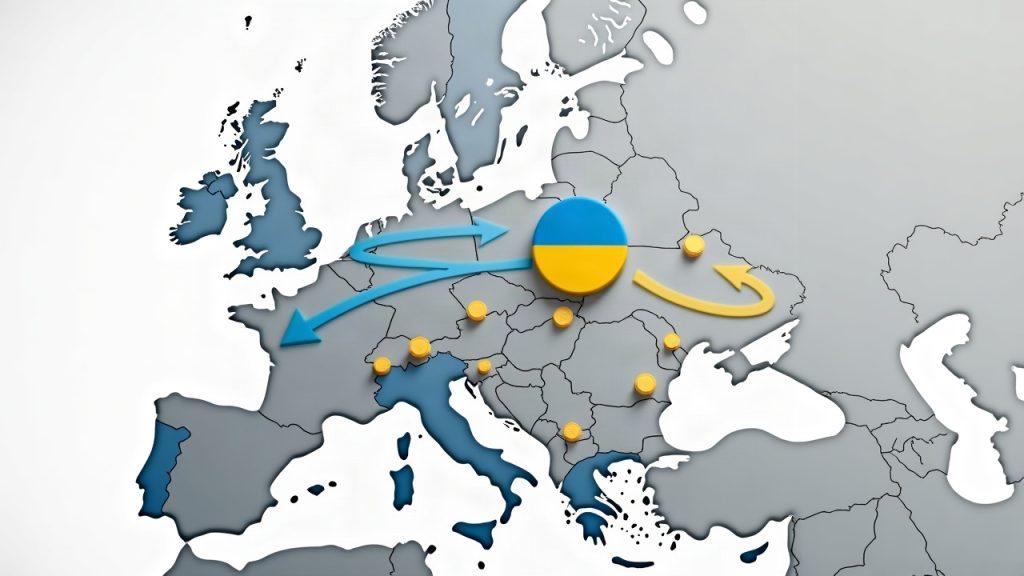
Eastern Europe’s crypto economy contracted 7.9% in the year ending June 2026, falling from $697.1 billion to $642.1 billion as the wider global market declined. According to the official Chainalysis report, the region recorded the weakest performance among the eight geographic markets tracked, compared with a 1.6% global decline. The headline contraction, however, masks a sharp divergence between large service flows and smaller peer-to-peer activity.
Transfers of $10,000 or more to crypto services fell from $591.5 billion to $488.6 billion, while retail-sized transfers grew 8.3%. Transactions below $10,000 consequently represented 13.1% of value sent to crypto services, the highest proportion among the regions studied and above the 10.1% global average. Domestic peer-to-peer volume moved even further against the regional trend, increasing 330% year over year.
Ukraine Draws $12 Billion in Stablecoin Flows
Ukraine remained one of the clearest examples of that divergence. Chainalysis measured $12 billion in cross-border wallet-to-wallet stablecoin flows into the country during the period, while the narrower category of retail transfers below $10,000 accounted for $2.41 billion. The two figures measure different slices of activity and should not be treated as interchangeable estimates of conventional remittances.
The geographic pattern was unusually concentrated. Among 21 markets with at least $5 million in outbound retail stablecoin P2P activity, Ukraine was the largest destination for 16 and ranked among the top three destinations for 19. The median market sent 27.7% of its qualifying retail stablecoin flows to Ukraine, while Moldova directed nearly 45% of its cross-border wallet transfers there. Chainalysis found a strong relationship between these flows and the size of Ukrainian diaspora and refugee populations in sending countries.
Canada was the largest source of retail-sized, remittance-like transfers in absolute terms at $359 million, despite several European countries having larger Ukrainian refugee populations. The pattern adds real-world evidence to the expanding role of stablecoins in cross-border payment rails, where wallet-based settlement increasingly operates alongside traditional payment infrastructure. Still, an on-chain transfer to Ukraine cannot establish whether the underlying purpose was family support, business settlement, savings or another form of value movement.
Retail and ATM Activity Defy Regional Decline
The contraction was also uneven between countries. Russia remained the region’s largest crypto economy at $284.1 billion but declined 14.7%, accounting for roughly 44% of Eastern European activity. Belarus grew 27.6%, while Ukraine, Moldova and Bulgaria posted much smaller gains. Ukraine itself remained nearly flat at 0.2% growth despite the broader 7.9% regional contraction.
Cash-linked crypto infrastructure moved in the opposite direction. Value received by Eastern European crypto ATMs nearly doubled from $17.3 million to $33.9 million, with Poland and Romania generating 92% of the increase. Poland alone accounted for 39% of regional ATM value, while its ATM transactions rose 120% and centralized exchange activity declined 5%. About 90% of Polish crypto ATM transactions involved stablecoins rather than Bitcoin.
Poland’s wallet-to-wallet activity showed a similar change: stablecoin P2P volume quadrupled while Bitcoin P2P fell by roughly one-third, with monthly stablecoin transfers overtaking Bitcoin in March 2026. That shift comes as European regulation increasingly influences which stablecoins and services reach users, with MiCA moving from broad principles into enforceable operating rules and USDC gaining a larger share of euro-denominated stablecoin trading. Stablecoins are therefore gaining ground in Eastern Europe even as the region’s aggregate crypto activity contracts.
The regional picture is consequently less about a uniform retreat from crypto than a change in where activity is concentrated. Large transfers to services declined, while domestic P2P, retail transactions, stablecoin corridors and crypto ATMs proved substantially more resilient. Eastern Europe’s $642.1 billion market became smaller during the 2026 measurement period, but its transaction mix shifted toward smaller and increasingly stablecoin-driven flows.