

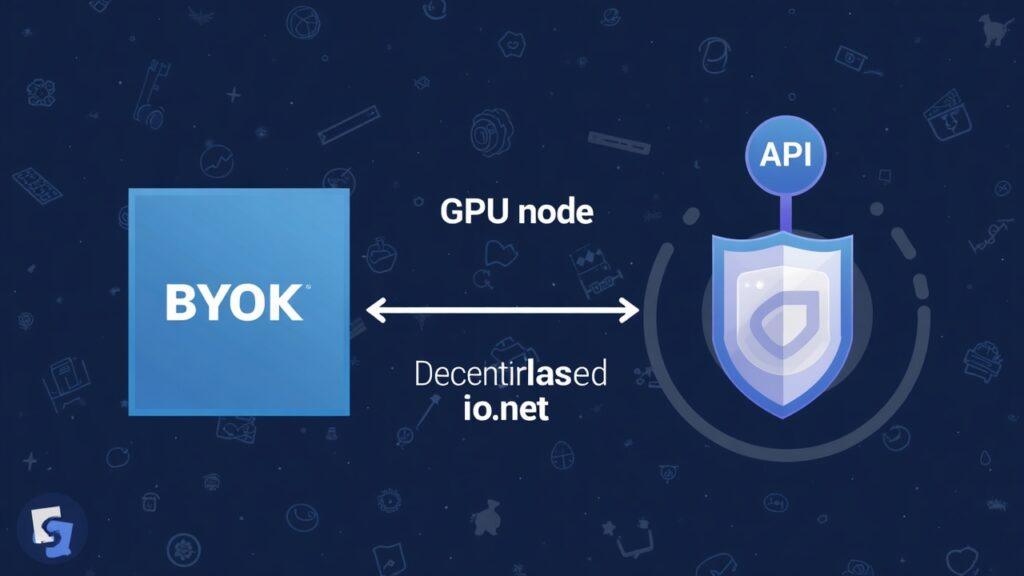
io.net has launched its Bring Your Own Key integration with OpenRouter, letting users connect an io.net account directly to OpenRouter’s unified API. The setup is designed to work with the same SDKs developers already use, without requiring code changes.
The integration keeps billing isolated to the user’s io.net balance, while OpenRouter handles unified routing through its existing API layer. io.net says requests are prioritized toward io.net infrastructure, with fallback controls remaining available to users.
Now live: OpenRouter BYOK x https://t.co/WLXlHkvE4z.
Plug your https://t.co/WLXlHkvE4z account into OpenRouter's unified API. Same SDK. Zero code changes.
– Your account, your rate, your quotas
– Billing isolated to your https://t.co/WLXlHkvE4z balance
– Fully transparent
-… pic.twitter.com/p1T8h9TunQ— io.net (@ionet) July 1, 2026
BYOK Model Reduces Developer Friction
Decentralized GPU access becomes easier to consume through an existing API workflow. Developers already building through OpenRouter can route workloads through io.net without rebuilding application logic around a separate compute interface.
OpenRouter’s BYOK framework supports provider-priority routing and fallback behavior. Its documentation says user-provided keys can be tried first, while fallback settings allow users to decide whether requests can move to other OpenRouter endpoints if a provider fails or hits limits.
The pricing structure includes a free monthly BYOK allowance followed by a 5% fee. OpenRouter’s own BYOK documentation says the first 1 million BYOK requests each calendar month are free of the platform fee, after which the 5% BYOK fee applies.
That structure gives io.net a way to present decentralized GPU routing as a lower-friction alternative to conventional hosted AI infrastructure. The project also says the model avoids hyperscaler markup and removes black-box billing from the compute path.
Adoption and Performance Remain the Next Test
For AI infrastructure users, the integration shifts attention from model access alone to routing, billing transparency and compute provenance. The same application layer can now connect to io.net-backed compute while keeping cost accounting tied to a separate io.net balance.
The practical impact will depend on latency, reliability, fallback behavior and workload economics. A BYOK connection can lower integration effort, but sustained adoption will require stable routing and predictable costs under real developer demand.
The integration also reflects a broader trend across AI infrastructure. Decentralized compute networks are trying to compete not only on raw GPU supply, but on how easily their capacity can plug into tools developers already use.
For now, the confirmed development is that io.net’s OpenRouter BYOK integration is live, with isolated io.net billing, prioritized routing and a free monthly allowance before the BYOK fee applies. The next useful indicators will be usage data, developer uptake, latency performance and whether io.net routing becomes a durable part of OpenRouter-based AI workflows.