

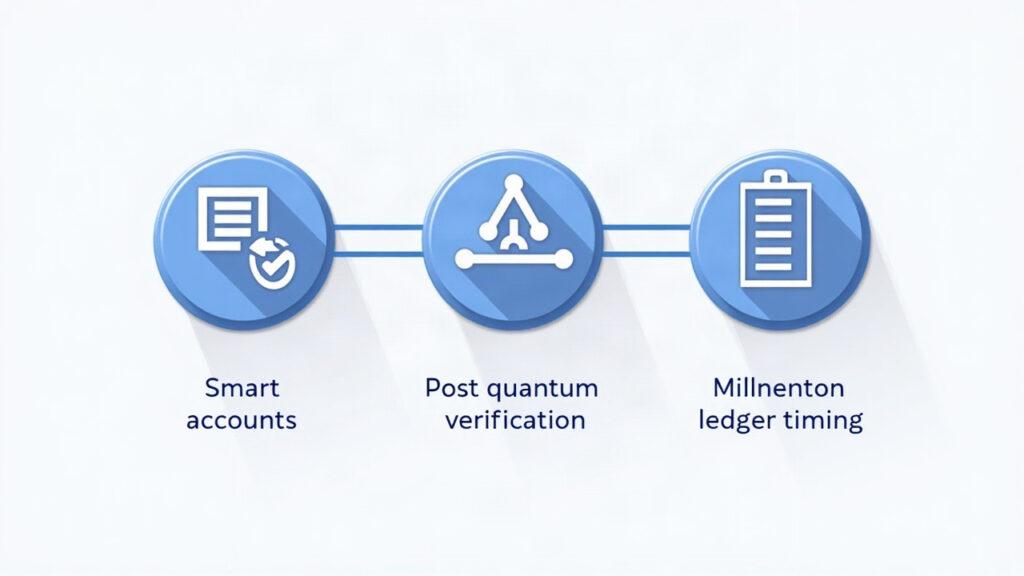
Stellar is preparing Bell, its Protocol 30 network upgrade, which introduces business-oriented smart account improvements, post-quantum signature verification and millisecond-resolution ledger timing. The changes aim to expand the blockchain’s technical capabilities, although activation remains subject to upcoming validator votes.
According to the Stellar Development Foundation’s official announcement, the upgrade incorporates three Core Advancement Proposals: CAP-84, CAP-87 and CAP-88. Each addresses a distinct limitation in Stellar’s infrastructure, from managing multiple customers through smart contracts to preparing for emerging cryptographic threats and faster ledger settlement.
Stellar Core v30.0.0 was released on October 16, 2026, but Protocol 30 has not yet been activated on mainnet. Validators are scheduled to vote on the testnet upgrade on November 3, followed by the mainnet vote on November 23, both at 17:00 UTC.
Bell Expands Smart Accounts and Post-Quantum Security
One of Bell’s most practical improvements concerns how businesses manage customer funds through smart contracts. Under CAP-84, muxed contract addresses will allow a single smart contract to identify transactions associated with different customers, reducing the need to deploy separate contracts for individual users.
The mechanism introduces addresses beginning with W that incorporate a 64-bit identifier. Exchanges, payment platforms and custodial services could use this structure to organize customer deposits while maintaining transaction records through contract events.
The change is particularly relevant to Stellar’s growing institutional infrastructure, which already supports tokenized financial products and initiatives involving confidential stablecoin architecture. However, muxed contract addresses primarily improve account organization, rather than providing transaction confidentiality or changing the legal ownership of assets.
Bell also introduces CAP-87, which enables ML-DSA post-quantum signature verification within Soroban smart contracts. The cryptographic standard was finalized by the US National Institute of Standards and Technology in 2024 and is designed to withstand attacks from sufficiently powerful quantum computers.
Instead of requiring developers to implement computationally expensive verification independently, Stellar will provide dedicated functions through its core software. This allows smart accounts to incorporate post-quantum authorization policies without reproducing the underlying cryptographic implementation.
However, Stellar’s conventional transaction signatures will continue relying on existing elliptic-curve cryptography. Bell therefore introduces a component of the network’s longer-term quantum preparedness strategy rather than making the entire blockchain quantum-resistant.
Millisecond Ledger Timing Lays Groundwork for Faster Settlement
The third proposal, CAP-88, changes how Stellar records ledger close times. Existing timestamps use whole-second precision, creating a technical limitation for future efforts to process ledgers at shorter intervals.
By introducing millisecond-resolution timestamps, Bell removes that restriction and prepares the infrastructure for potential subsecond ledger closes.
The proposal follows the September activation of Adapter, Protocol 28, which Stellar reported reduced mainnet ledger close times from approximately 5.7 seconds to five seconds. Bell does not independently deliver another immediate reduction, but establishes a prerequisite for future performance improvements.
The upgrade also requires coordinated preparation across the ecosystem. The official Protocol 30 upgrade guide instructs developers and infrastructure operators to update their software before activation.
SDK upgrades are necessary because CAP-88 changes the ledger header format, potentially preventing older decoding software from processing Protocol 30 ledger data. Applications handling account addresses must also recognize the new W format, while indexers and blockchain explorers need updated XDR definitions.
Existing Soroban contracts will remain compatible without modification, although developers adopting ML-DSA verification will need updated development tools.
The distinction between software availability and network activation is particularly important for blockchain infrastructure upgrades, where a published release does not automatically establish that new functionality is operational.
Stellar’s November validator votes will determine whether Bell’s proposed changes enter production, connecting immediate improvements in account management with longer-term objectives involving cryptographic resilience and ledger performance.